
pCloud Review 2026: Lifetime Plans, Crypto Add-On, Pros and Cons
What pCloud's monthly, yearly and one-time lifetime plans cost, when the lifetime price pays for itself, what the separate Encryption add-on protects, and how Sync.com, Icedrive, Proton Drive and Tresorit price against it in November 2026.

pCloud is worth it in 2026 if you will keep the storage for five years or more: the 2 TB lifetime plan costs the same as five years of its yearly plan, then keeps running. Premium 500 GB is $219 lifetime, and Ultra 10 TB is $299.99 a year or $1,499 lifetime. Zero-knowledge encryption is not included: the Encryption add-on is a separate purchase.
For a privacy buyer, the real price of 2 TB is therefore $649 once or $149.98 a year with encryption, our arithmetic. Choose pCloud lifetime for long-horizon personal storage you want paid off, Sync.com or Icedrive if you want encryption included in the base price, and Tresorit if you need audited business-grade sharing controls. Prices were read on pCloud's pricing pages on November 4, 2026.
Key factsBest for: Long-term personal storage you want to pay for once, with…
- Swiss cloud storage sold monthly, yearly or as a one-time lifetime plan, with client-side encryption as a paid add-on.
- Lifetime break-even: About five years of yearly billing on the 2 TB and 10 TB plans
- Encryption add-on: $150 lifetime, not included in any storage plan
- Money-back window: 14 days from the day of payment
- Free plan: 2 GB at signup, up to 10 GB by completing tasks
Pros
- Lifetime plans cost about five years of yearly billing and run 99 years or the owner's lifetime, with no inactivity clause.
- Choice of Luxembourg or Dallas data region at signup, with all files and metadata kept in that region.
- Free plan grows to 10 GB and shared links get twice your storage in monthly traffic on paid plans.
Cons
- Zero-knowledge encryption is a separate purchase on top of storage, and lifetime storage plans do not include it.
- Lifetime upgrades charge the full new price, and Extended File History cannot restore files deleted from the Crypto folder.
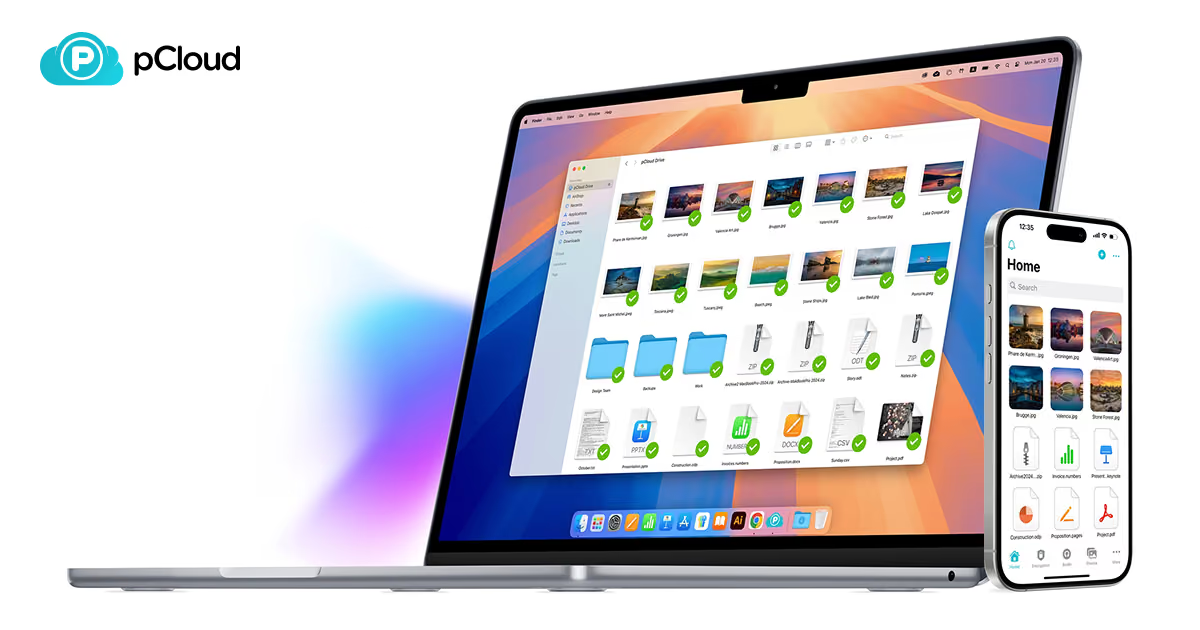
pCloud is one of the few cloud storage services that still sells its main plans as a single payment. That changes the buying question from "which tier" to "how long will I keep this", and it is a big part of why buyers compare it so often with Sync.com and Proton Drive.
The catch for a security-minded buyer is that pCloud's zero-knowledge encryption is a separate purchase, so the advertised price is not the price of private storage.
This review prices every pCloud plan from its own pricing pages, works out when the lifetime option beats paying yearly, explains what the Encryption add-on does and does not cover, and lists the terms that cost money later. It then sets pCloud against four encrypted alternatives using each vendor's published prices, read on the same day.
What is pCloud?
pCloud is a Swiss cloud storage service for personal files, families and small businesses, with desktop sync, a virtual drive, mobile photo backup, link sharing and a built-in media player.
At signup you pick where files live: the European Union in Luxembourg or the United States in Dallas, Texas, per its data regions page. Standard pCloud storage is protected with TLS in transit and 256-bit AES at rest, but only the paid Encryption add-on is client-side and zero-knowledge.
pCloud Encryption, which the terms of service call pCloud Crypto, puts files in a Crypto folder that is locked with a passphrase pCloud never holds. Encryption happens on your device, so pCloud has no information about file names or types inside that folder.
Lose the passphrase and the files are gone for good. That is the trade every zero-knowledge product asks you to accept, and a password manager is the place to keep it. The product profile is on Toolradar.
How pCloud works
You install pCloud Drive on your computer, which mounts your cloud storage as a virtual disk without filling the local drive, and add folders to sync or back up. Mobile apps upload your camera roll.
Shared links draw on a monthly traffic allowance: 50 GB on Free, and on paid plans twice the storage you bought, so 1,000 GB a month on Premium 500 GB, per pCloud's plan details article.
Recovery is where the plans differ. The help center's file recovery article keeps deleted files, previous versions and Rewind snapshots for 30 days on Free and 60 days on paid plans.
The pricing page card says paid plans recover data from up to 30 days ago. The vendor's own pages differ, so plan your recovery window around the shorter figure. The Extended File History add-on stretches all three to 365 days. It is not retroactive, though, and it cannot restore files deleted from the Crypto folder.
For ransomware recovery, that means encrypted files sit outside the longest safety net pCloud sells.
pCloud key features
pCloud pricing
Prices were read on November 4, 2026 on pCloud's pricing page, its Encryption page, its Family page and its Business page. Premium 500 GB costs $4.99 a month, $49.99 a year or $219 once. Premium Plus 2 TB costs $9.99 a month, $99.99 a year or $499 once. Ultra 10 TB costs $29.99 a month, $299.99 a year or $1,499 once. The lifetime cards show those prices against struck-through figures of $279, $709 and $2,799. Encryption costs the same as Premium 500 GB on monthly and yearly billing, or $150 once, shown against $229.
Lifetime pays for itself in about five years against yearly billing, our arithmetic: the 500 GB lifetime price equals 4.4 years of yearly Premium, and the 2 TB and 10 TB lifetime prices each equal 5.0 years of their yearly plans. Encryption breaks even faster, in 3.0 years. A 2 TB account with Encryption costs $649 once against $149.98 a year, so the lifetime bundle is ahead from the fifth year if today's yearly prices hold. Yearly billing itself saves $19.89 a year on 2 TB against twelve monthly payments.
Family is lifetime only: $749 for 2 TB or $1,849 for 10 TB, shared among up to five members. Business is $9.99 per user a month on monthly billing for 1 TB per user, with the card priced for three users, and Business Pro is shown at $14.98 per user a month with a 25% discount label for 2 TB per user; the help center says yearly Business billing saves 20%. Alternatives, from each vendor's page the same day: Sync.com Personal 1 TB is $12 a month billed yearly, $9 for the first year under a 25% promotion; Icedrive sells 2 TB lifetime at the same price as pCloud's, with encryption included; Proton Drive Plus 200 GB matches pCloud's 500 GB monthly price; Tresorit Personal Essential 1 TB is $11.99 a month billed yearly. Toolradar data: Toolradar, the software directory we run, tracks 36 cloud storage tools as of November 4, 2026, and pCloud ranks third among them for side-by-side comparisons over the last 90 days, with 385, on its cloud storage ranking.
| Plan | Price | Best for |
|---|---|---|
| pCloud Free | $0 | 2 GB at signup, up to 10 GB; 50 GB of shared link traffic a month |
| pCloud Premium 500 GB | $4.99/mo, $49.99/yr or $219 lifetime | 500 GB storage, 1,000 GB link traffic a month, Docs and Photos |
| pCloud Premium Plus 2 TB | $9.99/mo, $99.99/yr or $499 lifetime | 2 TB storage, 4 TB link traffic a month |
| pCloud Ultra 10 TB | $29.99/mo, $299.99/yr or $1,499 lifetime | 10 TB storage, 20 TB link traffic a month |
| pCloud Encryption add-on | $4.99/mo, $49.99/yr or $150 lifetime | Client-side, zero-knowledge Crypto folder locked by your passphrase |
| pCloud Family (lifetime only) | $749 for 2 TB, $1,849 for 10 TB | Up to five private accounts sharing one storage pool |
| pCloud Business | $9.99/user/mo monthly, 3 users minimum | 1 TB per user, teams, activity logs, 180-day file history |
| Sync.com Personal 1 TB | $12/mo billed yearly; $9/mo first year (promotion) | End-to-end encryption on every file |
| Icedrive 2 TB lifetime | $499 once | Zero-knowledge client-side encryption included |
| Proton Drive Plus 200 GB | $4.99/mo, monthly billing | End-to-end encryption, 10 years of file versions |
| Tresorit Personal Essential 1 TB | $11.99/mo billed yearly | End-to-end encryption, 10 file versions, remote device wipe |
pCloud pros and cons
What we like
- Lifetime plans cost about five years of yearly billing and run 99 years or the owner's lifetime, with no inactivity clause.
- Choice of Luxembourg or Dallas data region at signup, with all files and metadata kept in that region.
- Free plan grows to 10 GB and shared links get twice your storage in monthly traffic on paid plans.
What could be better
- Zero-knowledge encryption is a separate purchase on top of storage, and lifetime storage plans do not include it.
- Lifetime upgrades charge the full new price, and Extended File History cannot restore files deleted from the Crypto folder.
Who pCloud is for
pCloud lifetime fits a person or household that knows it will keep a fixed amount of storage for years: a photo archive, a document vault, a freelancer's finished projects. It suits privacy-minded buyers who want a US or EU data region and are willing to pay once for the Encryption add-on to keep the sensitive part zero-knowledge.
If you would otherwise pay a yearly storage bill for the next decade, the lifetime price is the cheapest contract in this review.
Who should skip it: anyone who needs every file zero-knowledge by default, because only the Crypto folder is, and a team that needs audited admin controls on encrypted sharing, where Tresorit is built for the job. Skip lifetime too if your storage needs will grow fast.
Upgrades stack at full price rather than crediting what you already paid, so outgrowing 500 GB means buying a second plan.
For backing up whole computers rather than storing files, compare our Backblaze review and IDrive review, and keep the recovery side in the ransomware response playbook.
Best pCloud alternatives
If pCloud is not the right fit, these are the closest options.
| Tool | Best for | Starts at | |
|---|---|---|---|
| pCloud | Long-term personal storage you want to pay for once, with an optional zero-knowledge folder. | 500 GB $49.99/yr or $219 once | Visit → |
| Sync.com | Buyers who want end-to-end encryption on every file by default, not in one folder. | Personal 1 TB $12/mo billed yearly, $9/mo for the first year (25% off) | Visit → |
| Icedrive | Lifetime buyers who want zero-knowledge encryption included rather than sold separately. | 2 TB lifetime $499 once, 500 GB $229 once | Visit → |
| Proton Drive | People already using Proton Mail or Proton VPN who want encrypted storage in the same account. | Drive Plus 200 GB $4.99/mo, Proton Unlimited 500 GB $12.99/mo on month | Visit → |
| Tresorit | Confidential documents that need encrypted sharing, remote device wipe and access logs. | Personal Lite 50 GB $4.75/mo, Essential 1 TB $11.99/mo, Pro 4 TB $27.4 | Visit → |


The bottom line
pCloud lifetime is a good deal for one kind of buyer: someone who will still want the same storage in five years and would otherwise pay yearly. The 2 TB lifetime plan matches five years of yearly billing and then keeps running. The terms define lifetime as 99 years or your own lifetime, and lifetime accounts escape the inactivity clause that deletes free accounts after 12 months. Budget for the Encryption add-on too if any of the files are sensitive, because standard pCloud storage is not zero-knowledge.
Skip pCloud, or pair it, when encryption must cover everything by default: Sync.com, Proton Drive and Tresorit encrypt every file end to end, and Icedrive includes zero-knowledge encryption in a 2 TB lifetime plan priced the same as pCloud's storage alone. Read the refund terms before buying a discounted lifetime plan: the money-back window is 14 days, and pCloud reserves the right to decline a refund on purchases made through a promotion or discount.
Related reading on this site: the best encrypted cloud storage ranking, the best backup software for small business, the Backblaze review, the IDrive review, the Proton VPN review, the best password managers for storing a Crypto passphrase, and the ransomware response playbook. Comparison profiles live on Toolradar for Sync.com, Icedrive and Proton Drive.
Methodology: every price on this page was read on the vendor's own pricing page, help center or terms on November 4, 2026. Promotional prices are labeled as promotions next to the regular price. Break-even years and multi-year totals are our arithmetic on those published prices and assume today's prices hold. Cyberpresso runs no test lab; product behavior is described from the vendors' documentation. Editorial policy: about Cyberpresso.
Cite this: Cyberpresso, "pCloud Review 2026: Lifetime Plans, Crypto Add-On, Pros and Cons", November 2026.
Frequently asked questions
Is pCloud worth it in 2026?
Are pCloud lifetime plans a good deal?
Does pCloud include zero-knowledge encryption?
Does pCloud offer refunds?
pCloud or Sync.com for private storage?
Sources
Prices and plan details come from each vendor's own pricing page, re-checked by the Toolradar pricing tracker.
- pCloud pricingchecked Sep 2026
Some offers on this page may be paid placements or contain affiliate links.
Get the Cyberpresso brief
Free daily newsletter, read in 5 minutes.
Subscribe free